
Have you ever asked yourself, what makes the stock market move up and down each day? The stock market might feel daunting in the beginning with lots of terminology shares, trading, indices but really it’s simply a collection of businesses and investors coming together. Once you understand how it works, you will be able to make informed decisions and get much more from your investment dollars. In this guide we will explain how the stock market works in a simple way, enabling you to start investing confidently.

The stock market is where buyers and sellers buy and sell shares of companies that are publicly listed (in other words, shares of companies that are publicly listed, traded on stock exchanges). You can consider it a marketplace for ownership of a company. Companies will get listed on a stock exchange when they have a need to raise capital. They will then make their shares available for investors who want to buy them if they feel they might be able to make a fair profit.
Example exchanges are the NSE or BSE in India, and also the (New York Stock Exchange) and NASDAQ (National Association of Securities Dealers Automated Quotations) in the world. When you buy a share, you own a small piece of that company. Ownership is good! The value of the shares may increase.
In order for a company to participate in the stock market, the company must go through the process of Initial Public Offering (IPO). In the IPO, the public has the opportunity to purchase the company’s shares for the first time. This process allows the business to raise capital for growth. Once the company is publicly listed, the company will then be traded on the stock exchange where the shares can be purchased and sold. When a company lists publicly through an IPO, there are regulatory bodies like SEBI in India that are responsible for ensuring the process has been transparent and that the investor is protected during the listing and afterwards.
Shares, or stocks, are equity interests in a company. When you buy a share, you are entitled to a proportional claim on the company’s profits. Typically, this is received in the form of dividends. The price of a share varies depending on the company’s performance, demand from investors, the level of news coverage surrounding the company, as well as other economic considerations. For example, if a company reports earnings above the projected forecast, the price of the share will move towards the higher end of the purchase price.
Conversely, if the company’s financials are reported as a loss, the price of the share may decrease significantly in response to the bad press. The first step toward a smart investment decision in stocks is to understand shares.

Stock exchanges are where shares are actually bought and sold between traders. In India, the main exchanges are the Bombay Stock Exchange (BSE) and National Stock Exchange (NSE). Stock exchanges are regulated environments that provide safety and fairness to all traders. Market participants (traders) access these markets online by going through brokerage firms. Every exchange has a set of companies listed and rules to govern, however, all the exchanges have the same goal – to pair buyers of shares with sellers of shares in a regulated and safe environment.
A stockbroker functions as the intermediary between you and the stock exchange. You cannot buy or sell stock through the exchange without going through a broker. Nowadays, many brokers provide the option to trade online from any phone or laptop. Popular brokers include Zerodha, Upstox, and Angel One. These brokers allow you access to real data, quickly with charts and tools already built-in to make fast and informed investment decisions.
Stock prices frequently change for several reasons. Supply and demand is the most important. If more people want to buy the stock, the price goes up. If a lot of people want to sell the stock, the price will go down. There are some things that affect stock prices, which include the company’s performance, economic news, interest rates, political stability, and global events. For instance, a government budget announcement will affect the price of certain stock whether it is bad for stockholders or good for stockholders depending on the budget announcement that affects the stock market.
Learning how to track those signals can help you make educated guesses at which way a sector stock may move.
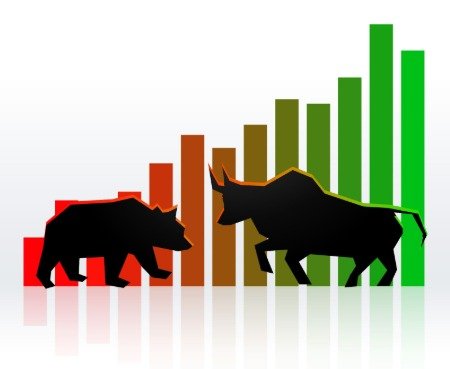
You will normally read the terms “bull market” and “bear market.” A bull market is when prices are rising or are expected to rise and a bear market is when prices are falling or are expected to fall. These terms give us a likely market reaction based on the sentiment or mood regarding a stock or investment. In a bull market, confidence builds, and people will purchase more. In a bear market, fear spreads, and people will sell everything they own. By identifying the mood of an investor, he/she can use this to identify a platform or position they may want to enter/ exit when trading.
The stock market can provide enormous returns, but it also has risks. Price can decline, a company can underperform, and the economy can worsen. Trading based on emotion, little research, or hearsay can lead to losses. As such, it’s very important that you develop and follow a plan, never invest more than you can afford to lose and continue to learn. Risk management will be one of the most important skills you can develop.
Although the stock market has the potential for huge returns on your investment, it is not without its risks as well. Prices can plunge, the companies you hold can fail or continue to decline in value, and in the worst-case scenario an economic downturn can take place. Financial losses can happen much too easily when traders emotional trade or don’t do their due diligence researching potential investments, or take other traders’ rumors at face value. Because of this, it’s critical to execute your plan, invest only what you can afford to lose, and continue to learn. Risk management is a key competency for traders who want to be successful.
Getting involved in the stock market with no knowledge is like trying to sail somewhere without a map. You may get somewhere, but more than likely you are putting yourself in a position to make mistakes and not understand how to manage your risk and make educated decisions. Knowing P/E ratio, market capitalization, and some chart formations can really help you. If you are investing for the long term or if you are attempting day trading, you will always start off with an educational purpose first. That is where trading courses can allow you to grow.
The stock market is a place where individuals buy and sell shares (or stock) from companies. If you want to invest your money in the stock market, it is worthwhile to learn a few basics, understand all the risks, and make intelligent choices. Regardless of whether you trade each day or invest for the long term, learning how the stock market works will allow you to make the best of your money and avoid pitfalls.
Start your trading journey the right way! Join our beginner course at Nexuswelthsoluation and learn how to invest smartly and with confidence.